

Last Friday an idea landed before lunch. By mid-afternoon it was a working product, deployed, replacing a 3,997-row spreadsheet I’d kept for years.
Three hours. Same-day idea to production.
Phase 4 of my roadmap — the twelve-month vision called Fusion Growth — quietly arrived on a personal expense tracker, of all things. I wrote about that moment in Build Log #3. What I didn’t write was what made it possible.
It wasn’t a smarter agent. The agent has been roughly the same for months.
What changed underneath it was a process spine. Six pieces of operating discipline that solo founders are told they don’t need at this scale.
These are the pieces that turn “interesting demo” into “in production by 3pm.”
What Got Built
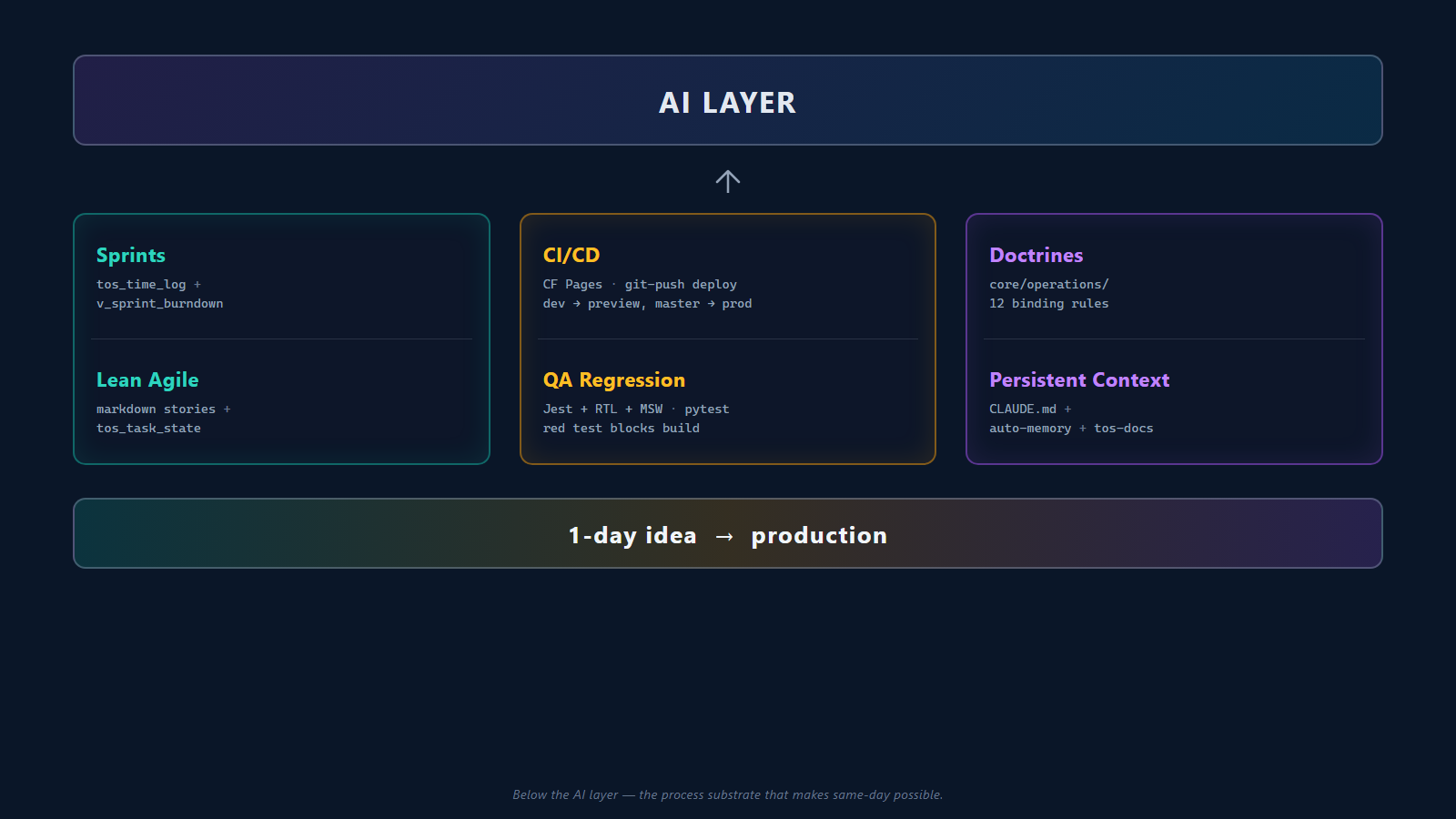
Six pillars, hardening in parallel since Sprint 1. Boring on their own. Lethal together.
1. Sprint cadence
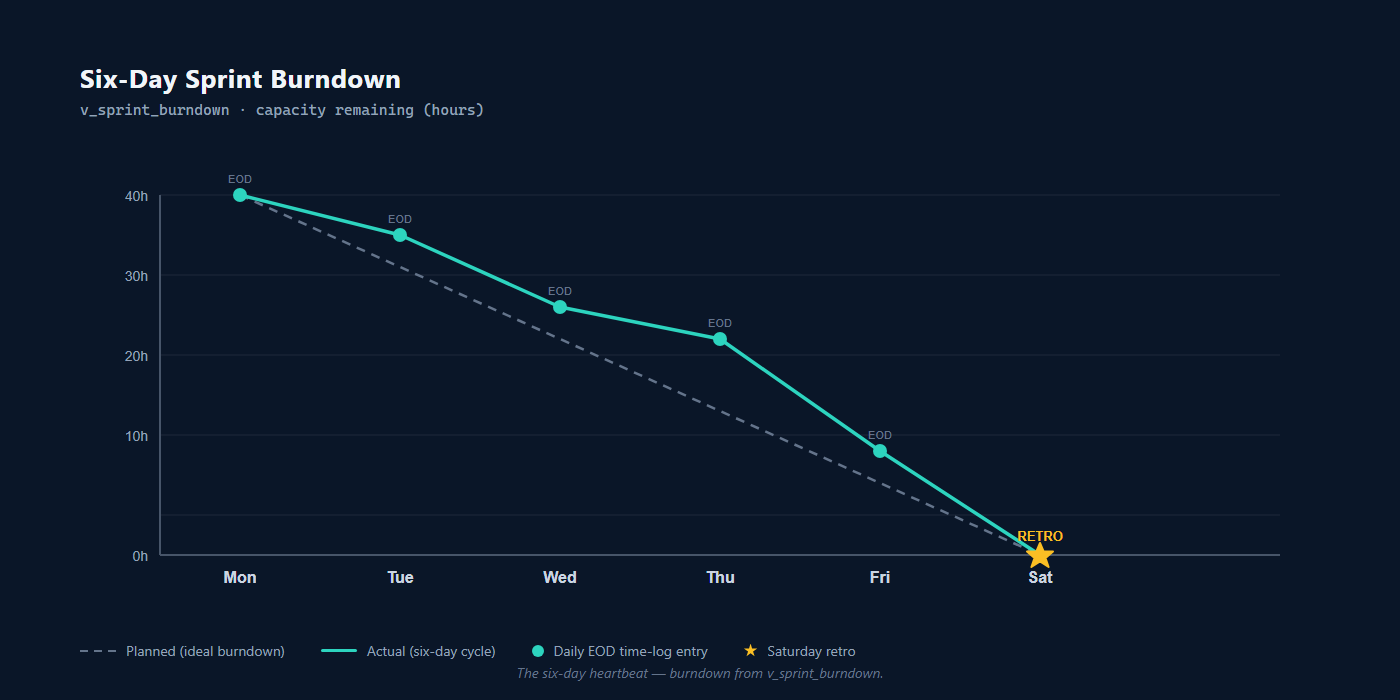
Six-day cycles, Monday to Saturday. Every day ends with a time-log entry in tos_time_log — what I worked on, time spent, time remaining. Every sprint ends with a retro and a re-baselined backlog. A Supabase view called v_sprint_burndown shows me where I actually am, not where I planned to be. Solo founders skip cadence because there’s no team to coordinate with. That’s the wrong reason. The cadence is the heartbeat. Without it the work expands to fill whatever window you give it.
2. Lean agile
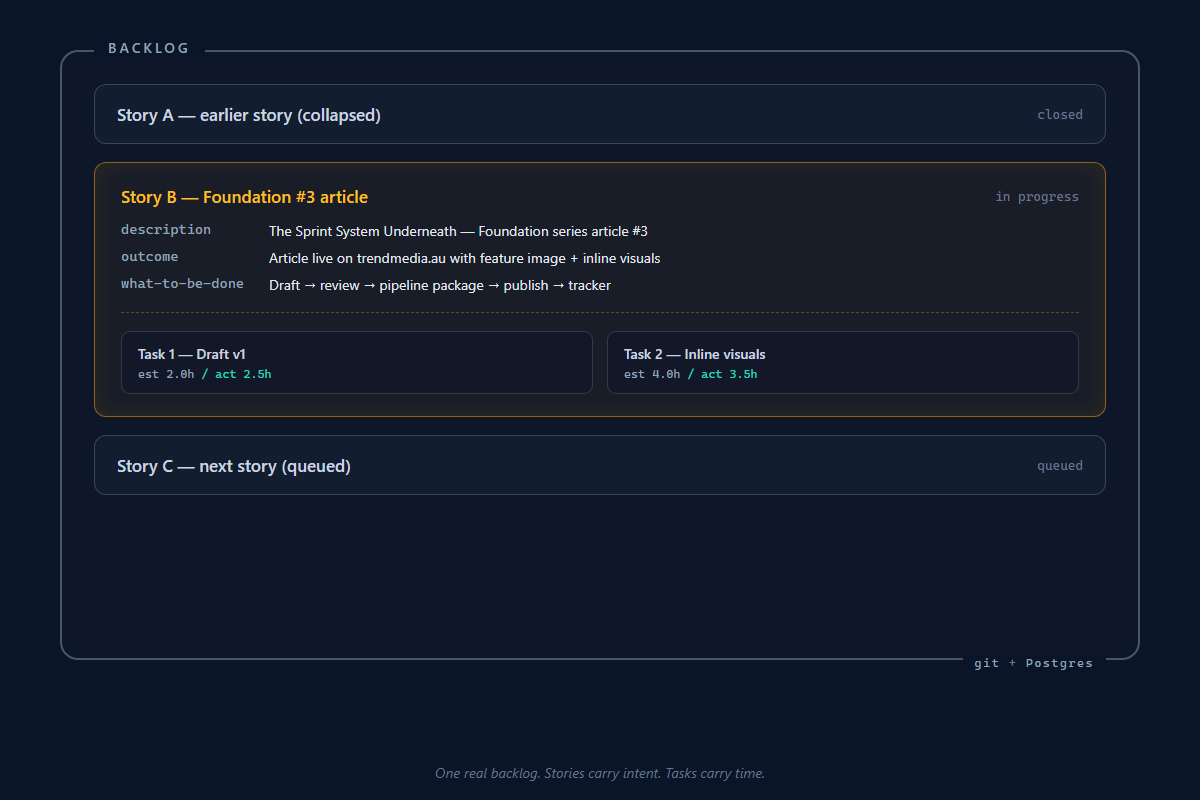
A real backlog, not a wish list. Stories with descriptions, outcomes, and what-to-be-done. Tasks underneath with estimates and actuals. All of it lives in markdown under projects/tri-venture-phase-01/ and in two Supabase tables — tos_task_state for live state, tos_time_log for accruals. The BUD portal renders it. The agent reads it. When I say “start task E27.1-3” the agent already knows the story, the outcome, and what’s done. There is no project-management software. There is git plus Postgres.
3. CI/CD
Every project deploys on git push. Push to dev and Cloudflare Pages builds a preview. Push to master and it builds production. No release windows. No manual deploys. No human gating the bytes between “it works on my machine” and “it’s live for users.” The pipeline is the deploy. taikim-finance went from local commit to finance.taikim.com in the same gesture I use to save a file.
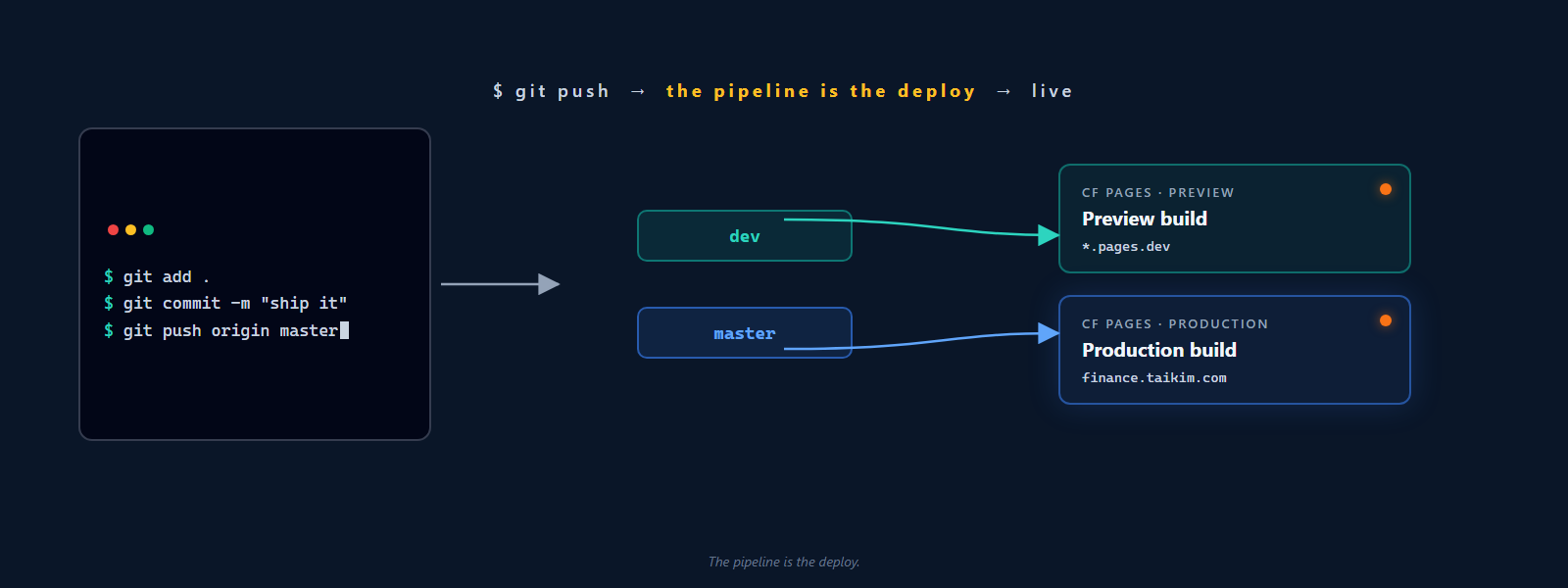
.pages.devand "Production" labelledfinance.taikim.com` — each with a small CF orange dot. Glowing arrows show the bytes flowing instantly with no human gate. Dark editorial background, electric blue accent on the master path, soft teal on dev. Clean modern flat illustration.*
The pipeline is the deploy.
4. QA regression
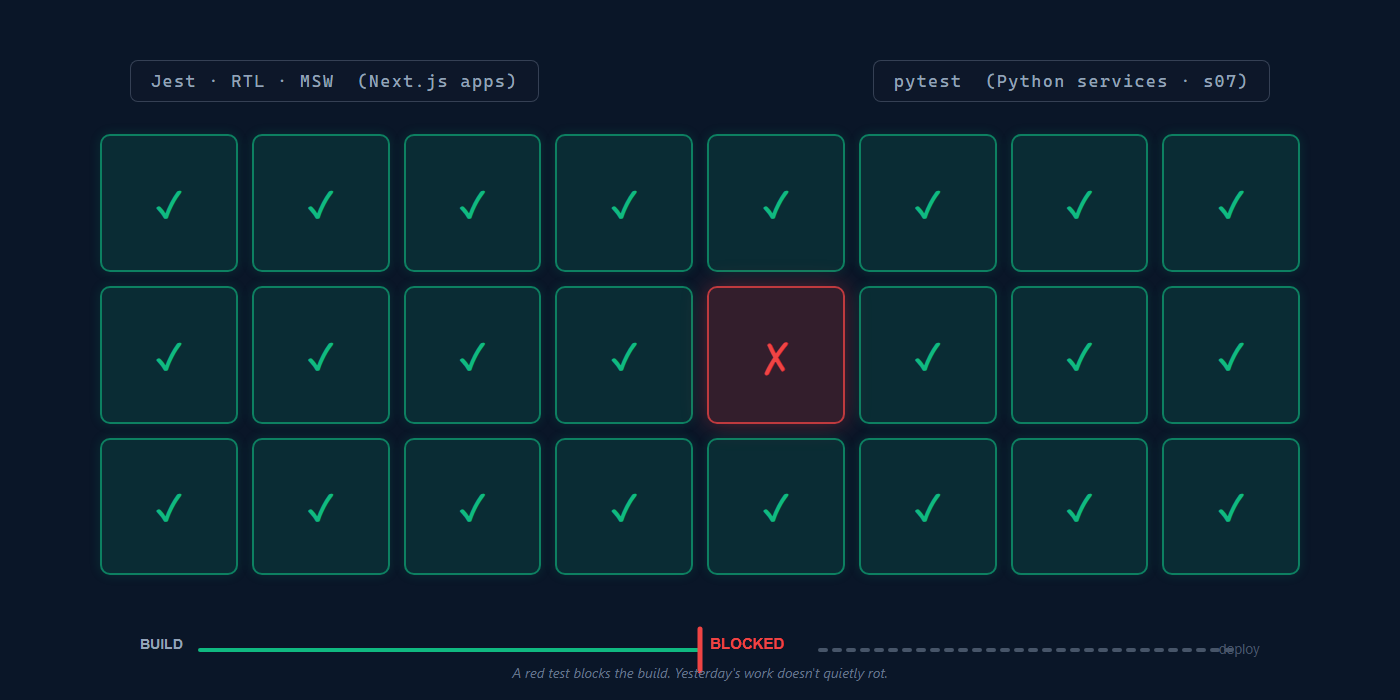
Each surface has its own test suite — Jest with React Testing Library and MSW for the Next.js apps, pytest for the Python services on s07. Tests run on every push. A red test blocks the build. Less elegant than a unified harness, more honest about what each app actually needs. Regression is not a nice-to-have when one operator is shipping six surfaces in parallel — it’s the only thing keeping yesterday’s work from quietly breaking under today’s commit.
5. Codified doctrines
Binding architectural rules, written down, that the agent applies without re-asking. Thin-host doctrine: everything in Docker, host stays minimal. Resumable-pipeline doctrine: every submission survives the back end going down. Web-design-defaults doctrine: every webapp ships with back-to-top, a custom favicon, and a theme switcher. Backup doctrine, monitoring doctrine, and more. Twelve of them now. Each one was a decision I made once and never have to re-litigate. They live in core/operations/ and the agent reads them before it writes a line of code.
6. Persistent agent context
A CLAUDE.md at the repo root that loads automatically every session. Per-project auto-memory under ~/.claude/projects/. A tos-docs repo that has grown thick enough to act as the business’s long-term memory. The result is what I called repeat-free working in Build Log #3 — I no longer re-introduce the ventures, the stack, or the rules each morning. The onboarding tax dropped to zero. Build Log #3 was about that shift. This article is about what it makes possible: cadence and discipline can finally compound, because nothing resets overnight.

The Decisions That Mattered
A few calls worth naming:
- Lean-agile lite over Scrum, Jira, or Linear. A single operator with an AI agent doesn’t need a ticket board, a ceremony stack, or assigned roles. Linear is great for teams; its queue model breaks when the assignee is always you. Notion pages rot by week three. Markdown stories in git plus a Supabase actuals table give me the 10% of Scrum that actually loads — backlog, story, task, estimate, actual, retro. The agent reads them the same way it reads code.
- Six-day sprints over the corporate two-week default — and over one-week. Two weeks at solo scale is forever; the burndown lies for nine days out of fourteen. One-week sprints leave no breathing room and every retro turns into a panic. Six days gives me a daily EOD log, a Saturday retro that actually pauses, and a Monday restart that feels like a fresh start instead of a hangover.
- Git-push deploys over manual release windows or approval-gated CI. Release windows are a team protocol that doesn’t exist when the team is one. Approval gates defend against people who weren’t on the keyboard ten minutes ago — also doesn’t exist. Cloudflare Pages auto-deploys on push:
devto preview,masterto production. The only gate is whether I typegit push origin masterinstead ofgit push origin dev— which is exactly the right one. - Per-project test suites over a unified harness like Nx or Turborepo. taikim-finance and trendmedia.au share nothing — different frameworks, mocks, fixture data. Forcing them into one rig adds coordination cost I won’t pay. Each surface owns its own regression: Jest + RTL + MSW for the Next.js apps, pytest for the Python services on s07. Less DRY, more honest, faster red-test signal.
- Doctrines as written artifacts over tribal knowledge or wiki pages. Memory drifts; agent memory drifts too. Wiki pages rot in a separate tool with their own access ceremony. If a rule lives only in my head or chat history, the next session re-debates it from scratch — and the agent reaches a different answer half the time. Doctrines in
core/operations/are git-tracked, agent-readable, and binding the moment they’re committed.
What This Actually Enables
The 1-day-to-production loop. Not as a stunt — as the working assumption.
When I think of a new tool now, my default expectation is that it ships today. The substrate is what bought that expectation. Sprints carry the cadence. The backlog carries the intent. CI/CD carries the bytes. Tests carry the safety. Doctrines carry the architecture. Persistent context carries the memory.
The agent reads all of it. I type the instruction. The work falls through the substrate and out the other side as a deployed product.
The Thesis, Revisited
Lean agile, CI/CD, sprints, QA regression — these are the practices the industry decided were enterprise-only. Too heavy for a solo operator. Overhead you can’t afford until you have a team.
That was true when the operator was just a human. It is no longer true when the operator is a human plus a resident agent that can keep up with all six pillars at once.
The question I keep asking myself — and now ask you — is this:
What’s the process layer in your business that you’ve been skipping because you’re the only one running it?
Put it in. The discipline you thought you couldn’t afford is the thing that makes everything else possible.
Same-day ideation to production is not a future promise. It’s what the substrate underneath the AI quietly enables, the moment you stop skipping it.