

The dread starts in your stomach.
You know the email is coming. The one that says “Notice of Audit.”
And everything stops.
For two weeks, maybe three, you’re not a care provider anymore. You’re an archaeologist. Digging through file cabinets. Chasing down signatures on faded paper. Taping together a story from a thousand scattered pieces of evidence.
You build the binder. That three-inch-thick monument to compliance. It’s heavy. It feels important.
But it’s a lie.
It’s a performance. A snapshot in time that proves you could get your act together for a single day. It says nothing about the other 364 days of the year. It’s a distraction from the real work. And you know it. The auditor knows it.
The whole thing is broken.
The Game Has Changed
The NDIS Quality and Safeguards Commission knows it’s broken, too.
They’re done with the performance. They’re done with the binder. The upcoming framework isn’t just another update. It’s a fundamental shift in thinking.
They are moving from a periodic audit to continuous demonstration of compliance.
Read that again. Continuous demonstration.
This isn’t a new burden. It’s a liberation. It’s the end of the fire drill. It’s a chance to build a system where the proof of your great work is simply a byproduct of doing it. Where evidence isn’t something you prepare, it’s something that exists.
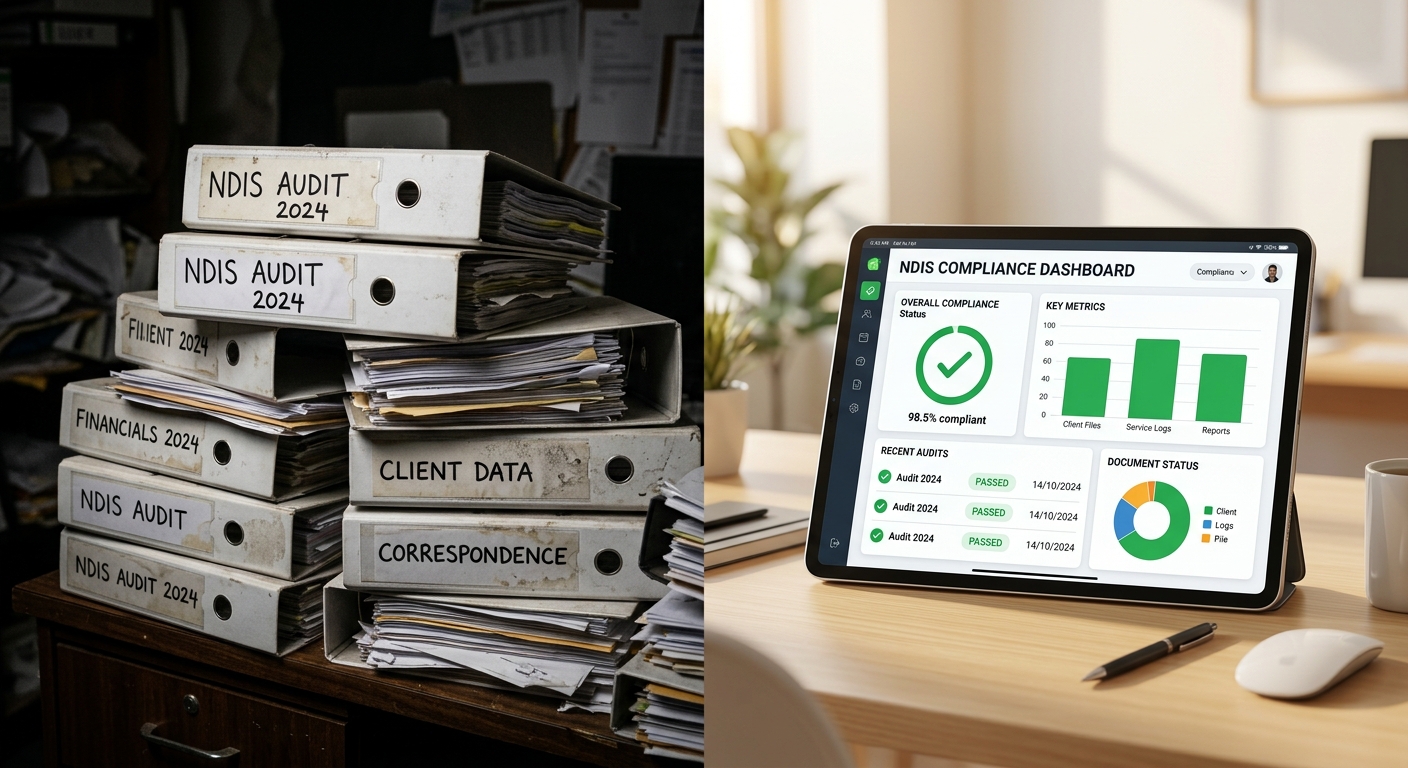
From Snapshot to Movie
Imagine this.
The auditor calls tomorrow. No notice. They say, “Show me evidence of consent for every participant’s plan update in the last 90 days.”
You don’t panic. You don’t even get up from your desk.
You turn your screen. You click a filter. A list appears. Every participant, every plan update, every consent form, time-stamped and attached. Clean. Simple. Undeniable.
They ask, “Show me which staff haven’t completed their mandatory incident management training.”
Click. A list of three names appears. The system has already sent them a reminder.
The audit is over in fifteen minutes. The weight is gone. You are free again, free to focus on care. This isn’t a fantasy. This is what “documented evidence available on demand” actually means.
How It Works: Evidence by Design
This isn’t about buying a six-figure software package. It’s not magic. It’s just smart design applied to a human problem. It’s built on three simple ideas.
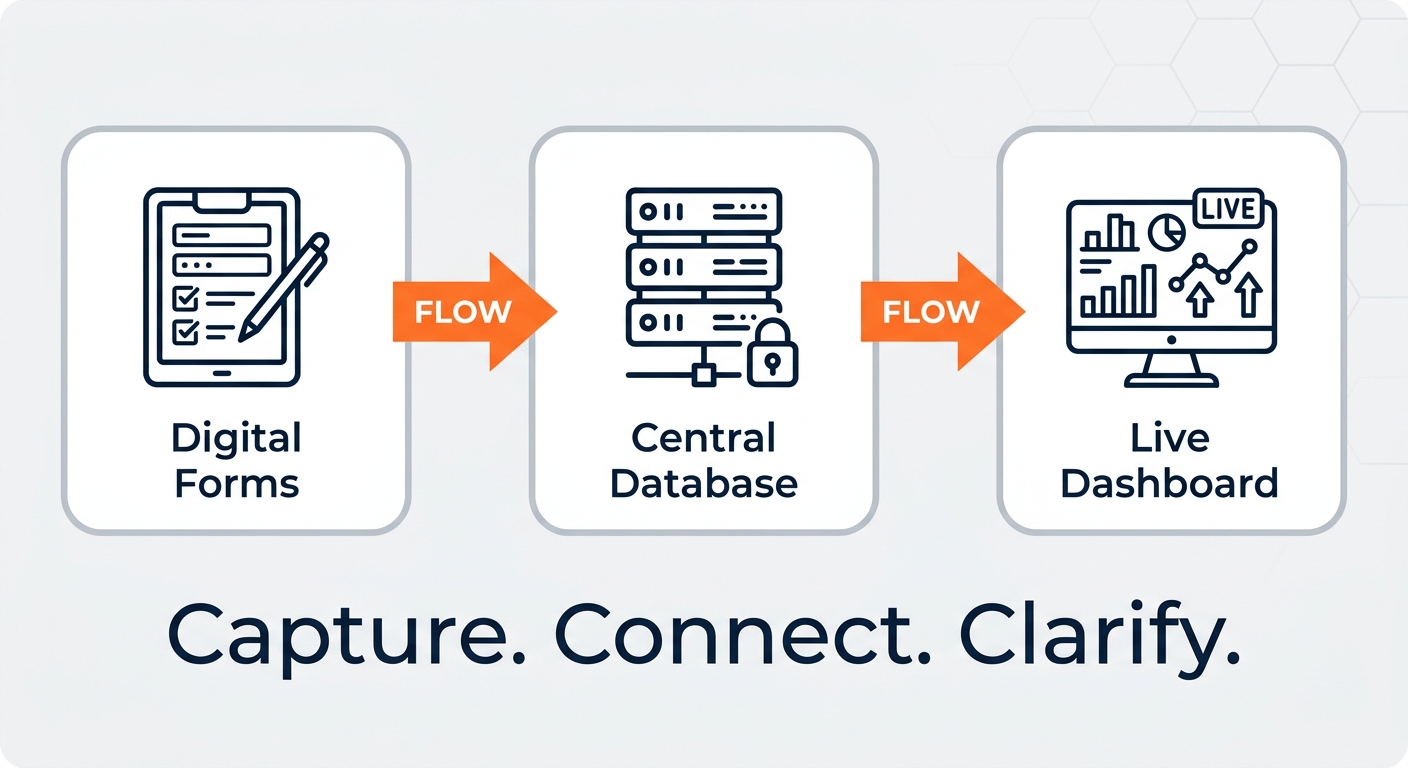
1. Instrument Your Workflow. Compliance doesn’t happen in a spreadsheet. It happens in the real world. When a support worker checks in. When a progress note is written. When a form is signed. You don’t add a “compliance step.” You build the evidence gathering into the tools you already use. The app your team uses for notes should be the same app that confirms the service was delivered to standard. The system becomes a silent, helpful witness.
2. Connect the Dots. A progress note is useless on its own. It needs to be connected to the participant’s goal, the staff member who wrote it, and the service booking that paid for it. Think of it like a digital thread. Every piece of evidence—a photo, a signature, a note, a training certificate—is a point on that thread. When you pull the thread, the whole story comes with it. Instantly.
3. Surface the Answers. If you do the first two things right, this part is easy. You don’t need a complex report builder. You need an answer machine. A simple dashboard that lets you ask a plain-language question and get a direct answer. It’s not about data. It’s about clarity.
You Can Build This Today
You don’t need a giant team or a blank check. You can start right now, with tools you already know.
Start by killing paper forms. Use Google Forms, Typeform, Microsoft Forms—anything. This turns your handwriting into structured data. It’s the most important first step.
Next, give that data a home. A simple database like Airtable or even a well-organized Google Sheet can act as your central log. Every form submission, every document upload, every key event gets its own row.
Then, automate the connections. Use a simple tool like Zapier or n8n to be the glue. When a form is submitted, it automatically creates a new record in your database. When a file is uploaded to a folder, it adds the link to the right record. This is the boring, invisible work that makes everything else feel like magic.
Beyond the Audit: Restoring the Soul of Your Work
This is about more than compliance. It’s about integrity.
When you stop spending your energy proving you do good work, you can pour all that energy back into doing good work. The system stops being a threat and becomes a partner. It doesn’t just watch; it helps. It nudges you when training is due. It flags a missing signature.
It allows a small, passionate provider to operate with the confidence and rigor of a massive organization. Because the truth of your quality is no longer buried in a binder. It’s alive, it’s real-time, and it’s always just one click away.
Getting this right is a design problem, not a paperwork problem. The NDIS Commission’s shift is an invitation to redesign your operations and shed the dead weight of the audit cycle for good. If you’re ready to see a purpose-built ‘answer machine’ for NDIS compliance in action, we can show you how to build one that fits the way you already work.
Brands mentioned in this article
 Google Forms
 Typeform
 Airtable
 Google Sheet
 Zapier
 n8n
n8n